
Automatic translation by Google. Limitations and info.
In focus
ReAct’s new strategic plan sets out how we will work to address antibiotic resistance in a world increasingly shaped by interconnected global challenges, including climate change, debt crises, growing inequality, armed conflicts, and weakened multilateral cooperation.
Recognizing that these crises are deeply linked and place growing pressure on health systems and societies, the plan focuses on three strategic priorities. Click to read more.

In the last 70 years the use of antibiotics has been crucial in improving countless lives and drastically reducing deaths caused by bacterial infections. The increasing development of antibiotic resistance is posing a serious threat to human health and development, the environment and for animal health. Learn more about antibiotic resistance here.
News
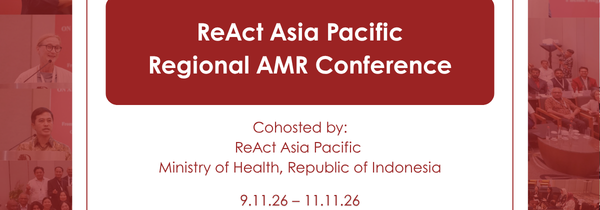
The Asia-Pacific region carries a disproportionate share of the global burden of AMR and includes countries with widely differing health system capacities, financing environments, epidemiological profiles, and implementation challenges.
The coming ReAct Asia Pacific Regional AMR Conference in November has an important role to play.

ReAct story
Sarah Rauzana, member of the Asia Pacific Youth AMR Task Force talks about why antimicrobial resistance (AMR) needs to move beyond the health sector, what environmental advocates can bring to the One Health conversation, why vulnerable communities must be at its centre, and how young people across the region can build a lasting movement against AMR.

Policy
On 1 October, the AMR Multi-Stakeholder Partnership Platform convened global multi-stakeholder consultations on the Abuja Compact together with the Government of Nigeria, host of the upcoming Ministerial Conference on Antimicrobial Resistance in December.
ReAct took the floor at the consultations, building on the detailed written submissions we sent in beforehand.

Release
The publication “Reimagining Resistance: A Journey in Creative Disruption” documents an intellectual and practical journey that began by questioning the language of AMR and evolved into a wider exploration of the relationships between humans, microorganisms and the living world.

News
On 2–3 September, ReAct Europe took part in an international conference on the recovery and modernisation of Ukraine’s healthcare system – Ukraine ReHealth 2026 – as part of its collaboration supporting Ukraine’s National Action Plan on AMR.

News
Children are often viewed as the beneficiaries of public health interventions, with adults making decisions on their behalf.
Yet, children are key stakeholders in their own right, capable of understanding health challenges, contributing solutions and influencing behaviours within their families, schools and communities.

Release
ReAct Latin America brings a complex public health challenge to life through theatre, puppets and the adventures of two unconventional detectives.

ReAct Story
Alla Kuzhel is Chief Nurse at the Municipal Non-Profit Enterprise “Children’s City Polyclinic No. 6” of the Odesa City Council. She is also a facilitator of peer support groups and curator of the project On the Waves of Nursing. Alla participated in ReAct’s online training on infection prevention and control in late 2025, and ReAct is looking forward to ways to collaborate.. In this interview, she shares her insights on addressing antibiotic resistance in Ukraine, a country currently facing the challenges of ongoing conflict.

ReAct Story
Meet Ndahafa Imene. Her journey as a medical laboratory scientist began with a simple curiosity to find out what happens to a patient sample after it is collected. This drive to understand the microscopic processes behind a diagnosis led her to the laboratory and a career as a research assistant for the Global Health Protection Program.
Now a participant in the Antimicrobial Resistance Leaders Program (AMRLEP), Ndahafa is turning her scientific expertise into leadership. In this interview, she shares her path to the frontlines of AMR stewardship and her vision for driving global change.

THEME
Aquaculture supplies more than half of the world’s seafood and plays a critical role in food security, livelihoods, and nutrition – particularly in low- and middle-income countries.
Yet the rapid expansion and intensification of fish and shrimp farming has also brought growing challenges, including infectious disease outbreaks and the widespread use of antibiotics.
These dynamics make aquaculture a key, and often under-addressed, front in the global action to contain antibiotic resistance, and more broadly, antimicrobial resistance.

ReAct is an independent network dedicated to the problem of antibiotic resistance. ReAct is a global catalyst, advocating and stimulating for global engagement on antibiotic resistance through a broad range of collaborations.